








Whether you’re looking to understand how infrared heat works, select the right emitter for your application, or optimise energy efficiency, you’ll find the key insights here. If you have additional technical questions that aren’t covered, our team is here to help—please contact us at [email protected].
Frequently Asked Questions
Calorific rays were discovered in 1800 by William Herschel when he used a prism to refract sunlight. Using a thermometer, he noticed an increase in temperature beyond the red segment of the visible spectrum. The wavelength of visible light lies in the range between 0.38 (violet) and 0.78 (red) microns, with infrared being ‘just beyond red’ and found between 0.78 – 1000 microns (μm). Over time, these calorific rays became known as ‘infrared’.
In scientific terms, infrared heat is a form, or wave, of electromagnetic radiation. The wavelengths primarily used for the industrial heat process range between 0.78 – 1000 μm.
Infrared is usually divided into 3 sections. The border between the divisions can vary depending on where you read it, as can the designation. At Ceramicx we use the following standard: – Short Wave Infrared: 0.78 – 1.40 μm. Also called Near Infrared [NIR] or IRA – Medium Wave Infrared: 1.4 – 3.0 μm. Also called Mid Infrared [MIR] or IRB – Long Wave Infrared 3 – 1000 μm. Also called Far Infrared [FIR] or IRC.
All objects – including us – above absolute zero (-273.15 °C) naturally radiate infrared energy, so in general terms, the answer would be ‘no’. While infrared can create enough energy to start molecules moving, unlike higher frequency radiation – such as x-rays – it doesn’t have enough energy to break molecules apart or cause damage. Infrared heat will naturally warm up whatever part of you it touches. But lengthy exposure to a high level of IR could be potentially harmful and result in a burn, in the same way as from any other heat source, such as a fire.
Infrared is a form of energy best thought of as waves moving through space that has different frequencies. From low frequencies, which make up radio waves, to high frequencies such as gamma or X-rays, with the visible spectrum of light our eyes can detect (from violet through to red), somewhere in the middle. Infrared (Latin for ‘below red’) is a form of radiation found just below visible light on the electromagnetic spectrum. When we absorb infrared, the only effect is that we feel warmer. However, IR can be hazardous with prolonged exposure.
The standard rated voltage is 230V. With other voltage ratings available on request, we can design the heating element to operate at different power outputs and with different voltage ratings for extra cost/minimum order.
Infrared emitters are frequently used under partial vacuum. The direct transfer of radiant energy is generally more efficient due to the absence of water vapour molecules which would normally absorb some of the infrared radiation.
This varies depending on the application, but we generally recommend 100-200mm for static applications where both heater and target are in a fixed position. Optimum distance depends on element spacing and the desired temperature uniformity across the surface. In general, the greater the distance, the greater the radiant dispersion, which in turn facilitates uniform heating. Shorter distances may lead to increased heat energy concentrated over a smaller area which can create localised high-temperature areas.
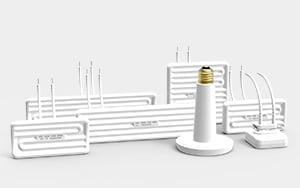
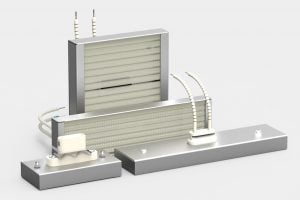
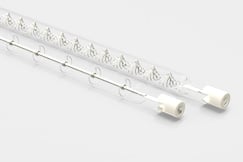
If the absorption characteristics of the target material are known, it may be possible to use peak emission wavelength as a means of choosing the most suitable emitter. If those characteristics aren’t known, small scale testing with 1 or 2 emitters may be enough to provide a better understanding of what works with the material in question. Another key factor is the thermal response time required by the process. Ceramic emitters typically require about 10-12 minutes to reach steady-state temperature. Quartz cassette emitters require about half this time, with tungsten/halogen emitters close to full output within a few seconds.
Under normal usage, ceramic emitters will last 20,000 hours or 12 months from date of manufacture. For quartz emitters, it’s 10,000 hours or 12 months from date of manufacture.
To monitor or control heat temperature for ceramic or quartz elements and heaters, we recommend using a Type K thermocouple. These can be used with a suitable temperature controller or monitor.
Again, this varies depending on application and emitter to target distance, but in general, small distances between emitters facilitate improved temperature uniformity. We generally recommend a minimum of 5mm between ceramic emitters when arrayed inside a heater field. We recommend the same with quartz emitters also.
For optimal stability, use a slot hole size of 42 mm x 15 mm with a reflector thickness between 0.75 mm and 0.9 mm. Increasing the size or thickness beyond these specifications may cause the pillar to weaken or break.
Bonus questions often asked….
Yes. When a customer needs an emitter or component custom made for their application, we’re always happy to discuss and develop new ideas. See our Capabilities.
Please visit our Ceramicx Solutions website for more information on heating systems.
With our global distribution network, Ceramicx is able to ship infrared heating products all over the world. Email us at [email protected] to find out more.
- Yes. Our publications page contains our most up to date product guide. However, designs and specifications are subject to change since going to press (Oct 25), so please check our product pages for the latest information